

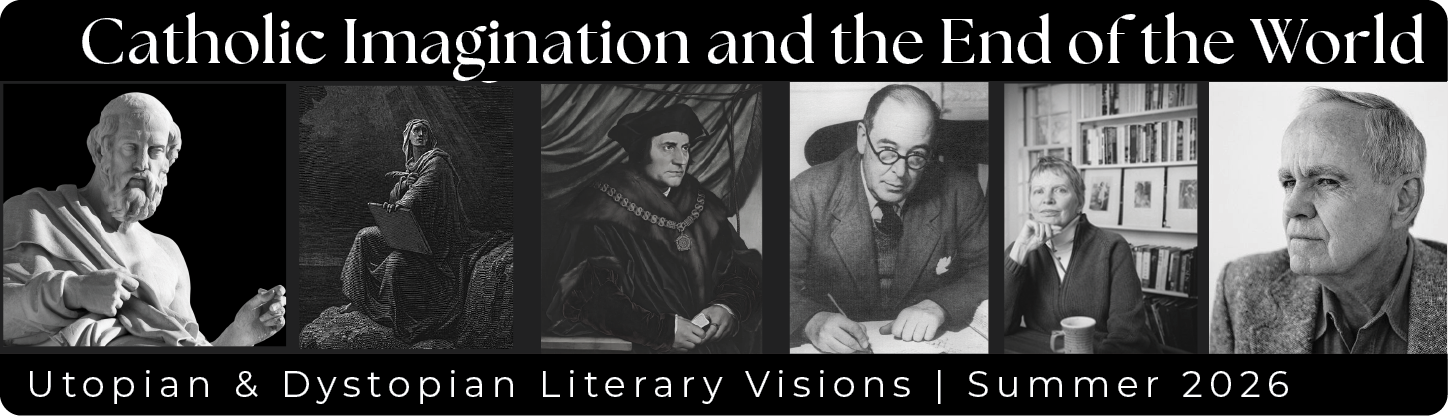
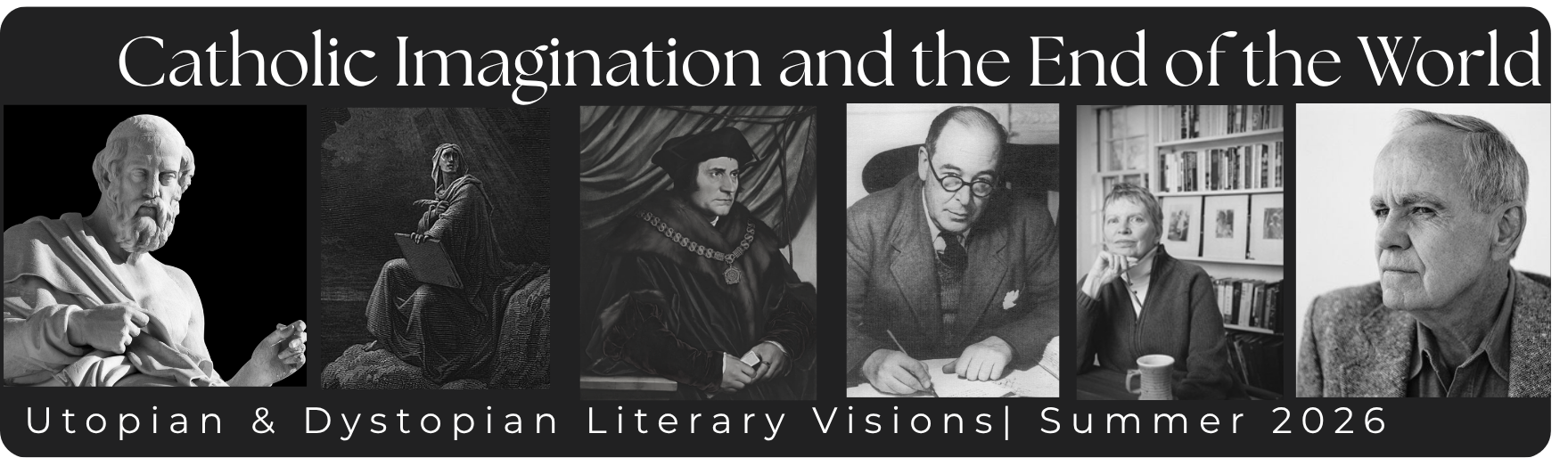
Throughout the ages, human beings across all cultures and religions have pondered the topic of the end of the world, offering perplexing answers to make sense of existence and cosmic destiny. How have Christians imagined the end of the world, and in particular Catholic Christians? And how might this relate to how non-religious persons might imagine it?
Continuing our annual summer book club series, “Literature & Catholic Imagination,” Divine Mercy Parish invites any and all persons – Catholic and non-Catholic! – to a book study where we read, explore, and discuss these and related topics.
This summer, we’ll explore the theme of utopia and dystopia by reading three modern classics:
- The Giver (1993), Lois Lowry
- A Newberry Award-Winning Young Adult Novel that many ages can enjoy!
- That Hideous Strength (1945), C.S. Lewis
- The wild, wonky, and imaginative third installment of the “Ransom” or “Space” trilogy, this work can be read apart from the others and is a prophetic picture of our times in many ways!
- Fun fact! George Orwell of the famed 1984 reviewed Lewis’ book before he wrote his work. Among his other praises and criticisms, he said this: “There is nothing outrageously improbable in such a [conspiratorial situation the novel presents]. Indeed, at a moment when a single atomic bomb – of a type already pronounced “obsolete” – has just blown probably three hundred thousand people to fragments, it sounds all too topical. Plenty of people in our age do entertain the monstrous dreams of power that Mr. Lewis attributes to his characters, and we are within sight of the time when such dreams will be realisable.”
- The Road (2006), Cormac McCarthy
- A dark dystopian novel of a blighted world that is searching and hopeful, despite the evidence. A masterpiece of American literature.
Readers can choose to read all or some of the books and journey with us as we open up the texts’ timeless and timely themes. In an age of both anxiety and optimism about the rapid pace of development in science and technology – perhaps most especially AI – we’ll examine how Christians and non-Christians might engage these perennial questions and ideas with a view to synthesizing both Faith and Science, and confronting our tendencies toward despair with hope.
For Catholics, the end of the world can be understood in at least two ways. More than merely an apocalyptic cataclysm, there’s something far more vital, foundational, and hopeful. Join us this summer for a book club that, despite the topic, is about learning how to cultivate hope, peace, and tranquility of heart in the midst of the anxieties of our beautiful, yet broken and battered world.
Whether you’re a person of Catholic Faith or no faith – or anywhere in between – come join us!