

Exploring Catholicism
What would it mean to become Catholic? How do I learn more?
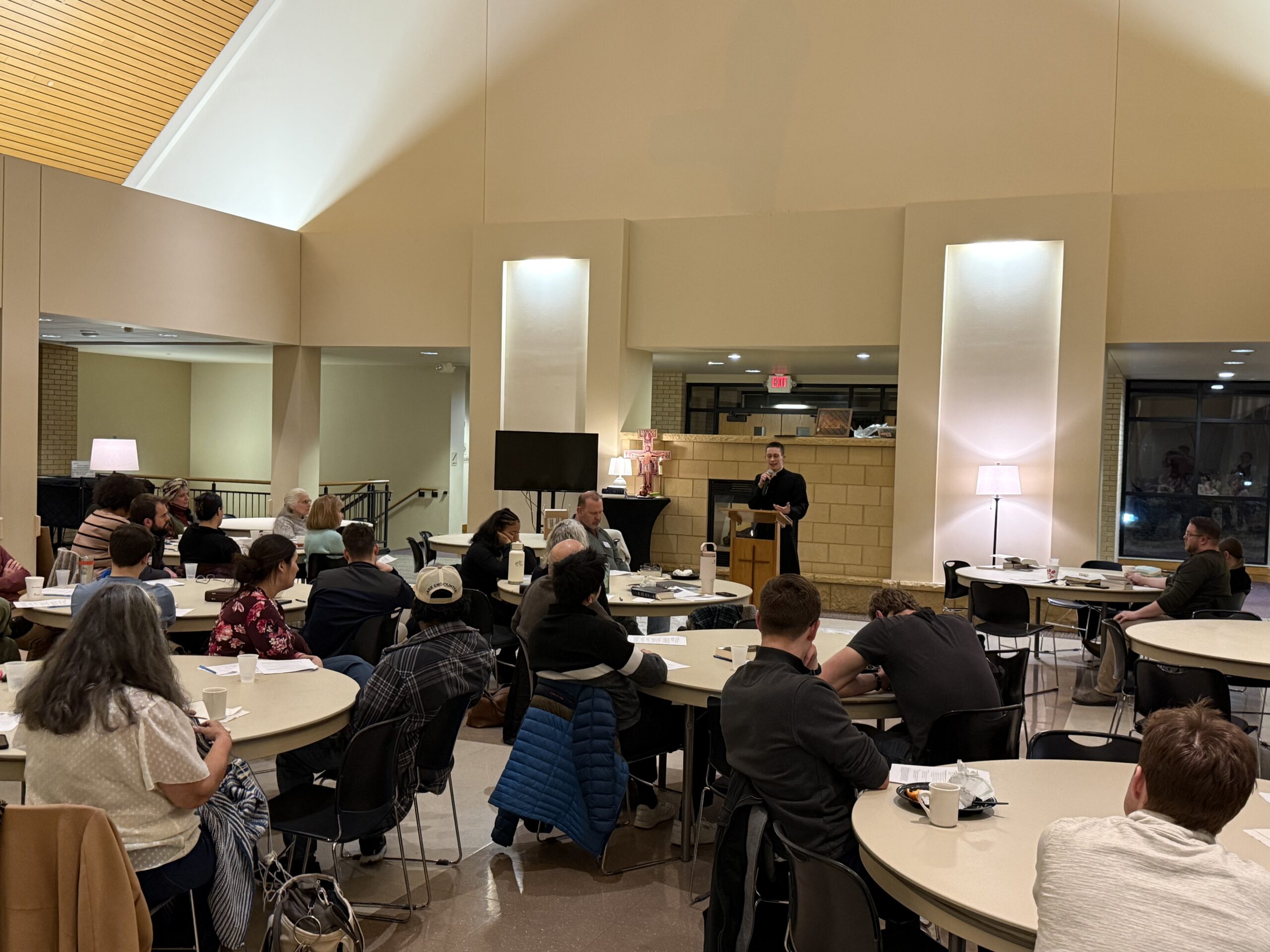
For those interested in exploring more deeply what it would mean to become a Catholic Christian, the Church provides a process called the Order of Christian Initiation of Adults or OCIA. The OCIA is open to those who have never been baptized, those baptized in another Christian tradition, and Catholics seeking deeper formation or preparation to receive Sacraments such as Adult Confirmation. Through ongoing formation and community support, participants grow in their knowledge of Jesus Christ and the Faith and Life of the Church, Christ’s Mystical Body. See more details below.
NOTE: For our upcoming 2026-2027 cohort, OCIA meetings begin Sunday, September 13, 2026, at 3:30 pm, and continue throughout the year. NOTE: we had originally planned to meet on SEPT. 6, but the Labor Day weekend is then and many will miss. Thus, the postponement ONE week. It is never too late to inquire or join! More specific details will be provided on an ongoing basis. Click the button below to inquire further and get on the email list for updates!
The OCIA comprises three aspects
Liturgical
The Church’s liturgical calendar, with its seasons and feasts, was created to welcome those entering the Church. Lent in particular accompanies participants in conversion, introducing them to the life of the Church and the grace flowing from Christ, the Head of His Body.
Catechetical
Catechesis — literally “to echo down the mystery” — hands on the Christian Faith, the mystery of God’s love revealed in Scripture, Sacred Tradition, Church teaching, and moral guidance. Participants receive this instruction in relationship with others who are inquiring and growing in faith.
Pastoral
Catechists serve as humble guides, attentive to each participant’s spiritual journey. Every person’s dignity, questions, concerns, and hopes are honored in an atmosphere of prayer, reflection, dialogue, and respect for their growth in Christ.
FAQs
What is the scope and sequence of the OCIA process?
OCIA progressively deepens not only the participant’s understanding, but also their faith formation in the Life and Faith of the Church. There are Four Stages of the OCIA, three of which are Rites, which are rituals that take place in the Church that not only meaningfully mark one’s spiritual progress, but also confer the Grace of the Holy Spirit.
The Pre-Catechumenate
This first stage is a time of inquiry in which all participants explore and ask questions and receive the kerygma or “proclamation” of the gospel (the evangel) or “good news” of the Christian message. This is what constitutes “evangelization.” All who are able are invited to freely choose to enter the Rites if and when they feel they are ready.
The Rite of Entrance into the Order of the Catechumens
This second stage is an extended period for pastoral formation and guidance aimed at training participants in the Christian life through a thorough process of catechesis. (“Catechumen” is the title given to those who have never been baptized. “Candidate for Full Reception” is the title given to those who have been validly baptized and desire to enter into full communion with the Catholic Church.)
The Rite of Election
This third stage is a period in which participants are called to continuing conversion that coincides with the season of Lent in which the participants engage in interior reflection, prayer, and meditation in anticipation of full entry into the Church. It is also known as the period of Purification and Enlightenment.
The Rite of Reception
In this fourth stage, the catechumens and candidates receive the Sacraments of Initiation – Baptism (for those not yet baptized), Confirmation, and Holy Eucharist. Once these Sacraments are conferred, this marks the full entry of the participant into the Church. (This usually occurs at the Easter Vigil on Holy Saturday evening, however, one can be received into the Church at any time, provided they have sufficient formation.)
Upon one’s entry into the Church, they begin their Neophyte Year, which is a year of further discipleship in the community of the local parish. This includes fellowship, teaching, and ongoing support in this year of “new growth.” The first period of this Neophyte Year includes a period of Mystagogy, an ancient term for a time of further formation in the neophyte’s understanding and participation in the Sacraments or Mysteries (sacrament is the Latin translation of the New Testament Greek word mysterion or mystery from which mystagogy is derived.)
What is the origin of the OCIA and its unfamiliar language?
The OCIA is the modern equivalent of what the earliest Christians called the Catechumenate. The “order” of the OCIA reflects one of the most ancient orders or societies in the Christian Church that precedes the religious orders (like the Benedictines, for example). That it is an order reflects the communal nature of the process and the religious aspect that is intimately connected to the spiritual vitality of the Church. To enter the OCIA is to enter a very ancient tradition of discipleship.
Check out this rich and helpful overview!What if I enter OCIA and don’t feel ready to enter the Church?
That’s ok. Participants are invited to progress through each stage of OCIA at their own pace in an ongoing process of discernment of one’s desire and readiness for commitment to enter the Church. Every participant’s story is different and all are invited to take the time they need to discern. There is never an obligation to join the Church upon entry into the OCIA program, but an invitation to continue to inquire and explore freely as one feels led.
When and where can I attend OCIA?
OCIA for Divine Mercy Parish meets from Fall to Spring/Early Summer (Pentecost). We gather most weeks during this period on every Sunday afternoon from 3:30 – 5:00 p.m. beginning at St. Maria Goretti Parish Hall. We break for Summer, but gather for periodic fellowship and our Summer Book Club. Dinner is provided every Sunday we gather!
A breakdown of what to expect on these nights is as follows:
- 3:30 pm | Meet at the St. Maria Goretti Parish Hall for Catechesis (Teaching and Discussion)
- 4:50 pm | Begin transitioning to the 5:00 pm Mass at St. Maria Goretti church
- 5:30 pm | Dismissal after the reading of the Bible and the Homily (Sermon) for shared dinner together
For our upcoming 2026-2027 cohort, OCIA meetings begin Sunday, September 13, 2026, at 3:30 pm, and continue throughout the year. NOTE: we had originally planned to meet on SEPT. 6, but the Labor Day weekend is then and many will miss. Thus, the postponement ONE week. It is never too late to inquire or join! More specific details will be provided on an ongoing basis. Click the button below to inquire further and get on the email list for updates!
What if I didn't make it to the first session? Can I enter OCIA at any time?
Do not worry. Although you may have missed the first session (or more), you may enter OCIA at any time. The process is meant to be flexible to accommodate inquirers’ circumstances. Reach out to Evangelization & Formation Coordinator, Matthew Farrelly, at matthew.farrelly@divinemercymadison.org with any questions you may have, or follow the link/button below to fill out a brief form where you can indicate your situation.
Interested in learning more about OCIA?
If you have any questions about the above or anything else besides, please do not hesitate to reach out to us! We are eager to learn more about your journey of faith and any questions or concerns you may have about Catholicism. Please follow the link below to register your interest in OCIA and to tell us a little about yourself. We would love to make a personal connection with you!
Inquire About OCIA
Other resources to get you started…
What is the Mass?
The Mass is the central act of Catholic worship, in which the Church gathers to hear God’s Word, offer praise and thanksgiving, and participate in the sacrifice of Christ through the celebration of the Eucharist, receiving His Body and Blood for spiritual nourishment and unity with Him.
Discover the meaning behind each part of the Mass with some more explanation as well as a guided walkthrough that explains the prayers, gestures, and rituals as they unfold.
New to the Mass?What are the Sacraments
The Sacraments are outward signs instituted by Christ that confer God’s grace, visible encounters with His love that strengthen faith, guide moral life, and unite believers to the Church. They include Baptism, Confirmation, Eucharist, Reconciliation, Anointing of the Sick, Matrimony, and Holy Orders.
Learn MoreHow is Catholicism distinct from other Christian traditions?
Catholicism is distinct from other Christian traditions in that it possesses the fullness of truth and Faith, rooted in Sacred Scripture and Sacred Tradition, guided by the teaching authority of the Church (the Magisterium), centered on the Eucharist as the true Body and Blood of Christ, and enriched by the seven Sacraments as means of grace for living a life of holiness.
To better understand how Catholicism compares to other Christian traditions, watch this introduction.
Watch NowHow is Catholicism different from other non-Christian Religions?
Catholicism holds two truths together: (1) other religions can contain real truth and goodness, and (2) Christianity claims that the fullness of truth is found in Christ and in the Church’s proclamation of him. This does not deny the truth of other religions, or, for example, what can be learned through scientific inquiry. Rather, Catholics believe that all have access to the truth of reality through natural revelation (in nature or creation), and that there are different ways of expressing that knowledge: through religion, art, and science, which harmonize. But Catholics also believe in divine revelation: that is, that God reveals God’s self to humanity. This he has done most fully in Jesus Christ and his Church.
To explore this idea more fully, watch the short video below.
Watch NowIs Catholicism Anti-Science?
Far from it! In fact, we can thank many Catholic scientist-priests for world-changing scientific discoveries, theories, and methods. Catholic teaching holds that faith and science are compatible because they belong to different orders of knowledge and must each use its proper methods; when both are pursued responsibly, they do not contradict one another. It may come as a surprise to people to learn that we can thank Gregor Mendel, an Augustinian Monk (like Pope Leo XIV!), who was also a biologist, meteorologist, and mathematician, for genetics. Or consider Georges Lemaitre, who was a Catholic priest — and a theoretical physicist and mathematician — who theorized the Big Bang. These are just two.
These videos on Faith & Science might make you marvel!
Watch Now
RESOURCES
FORMED.ORG
We are building our parish Resource Center for faith formation, including OCIA and lifelong learning materials. In the meantime, explore thousands of Catholic videos, talks, and study programs on Formed.org to grow in faith, prayer, and understanding of the Church.
Explore More